How digital payments, cards, and online accounts changed the modern world
 Corey Peterson
Imagine trying to live your life today using only coins and paper money. You’d need pockets the size of grocery bags, a hand sanitizer subscription, and the patience to wait in endless lines while people dig for nickels. Luckily, the world moved on—and quickly.
Over the last 70 years, money went from metal and paper to plastic cards… and finally to little glowing rectangles in your pocket. These changes didn’t just make life more convenient—they transformed the entire global economy, allowing businesses, families, and governments to move money instantly, safely, and across the world.
Let’s take a look at how digital payments reshaped everything we do.
Credit Cards: The First Big Leap into the Future

In the 1950s, the first modern credit cards appeared. Instead of carrying bundles of cash, people could now buy things with a simple piece of plastic that promised the merchant:
“The bank will pay you now—don’t worry, the customer will pay us later.”
This single idea changed everything:
- People could travel safely without carrying money
- Businesses got paid instantly
- Consumers gained flexibility and convenience
- A new system of credit scores and financial identity emerged
The world didn’t just adopt credit cards—it reorganized itself around them.
Debit Cards, ATMs, and Online Banking

By the 1980s and ’90s, debit cards and ATMs spread everywhere. Instead of waiting in line at a bank window, people could access their money 24/7. It was like having a miniature bank branch built into a wall.
Then came online banking, which made managing money:
- easier
- faster
- more transparent
- and way less scary than calling a bank and sitting on hold listening to jazz
Suddenly you could check your balance in seconds, move money between accounts, or send payments without ever stepping foot in a bank.
Digital Wallets: Apple Pay, Google Wallet & Tap-to-Pay

Today, the most powerful wallet isn’t the leather one in your pocket—it’s the smartphone in your hand.
With Apple Pay, Google Wallet, and tap-to-pay systems, money moves with:
- a fingerprint
- a face scan
- or a single tap
You don’t even need your physical card. Your phone becomes your card, your wallet, your bank… and sometimes your car keys, your ID, and your boarding pass. Digital wallets encrypt your payment details, making them safer than carrying a real wallet.
And let’s be honest: tapping your phone on a card reader makes you feel a little like a superhero.
Online Accounts: Money With No Physical Form

Bank accounts today are mostly digital entries on a secure computer. Your paycheck, your savings balance, your investment account—they rarely take physical form. Money now moves:
- instantly
- globally
- without ever existing as paper
This shift made global commerce possible on a scale humans could never have imagined. A teenager can send birthday money to their cousin across the world faster than it takes to microwave popcorn.
Crypto, Stablecoins, and the Blockchain Revolution
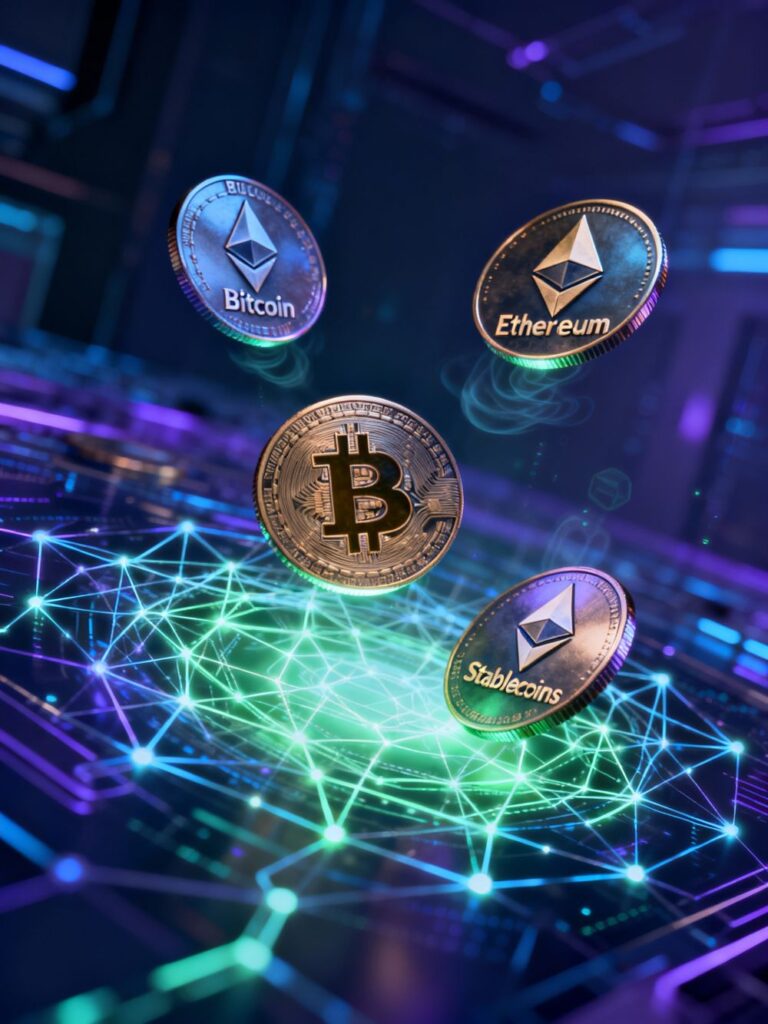
In 2009, something wild happened: money became programmable.
That’s when Bitcoin and the idea of cryptocurrency launched. Crypto isn’t printed by governments or backed by banks—it’s secured by blockchain, a global network that records transactions in a way that’s nearly impossible to tamper with.
But early cryptocurrencies had a problem: they were too volatile. One day your crypto could buy a bicycle; the next day it might buy only a slice of pizza. That’s where stablecoins came in.
Stablecoins are digital currencies designed to stay the same value—often tied to the U.S. dollar. They are now used worldwide for quick transfers, investing, and online commerce.
Blockchain and crypto are still evolving, but they introduced major ideas:
- Money can move without banks
- Transactions can be transparent and secure
- People can own digital assets without needing a physical item
- Future money may be entirely digital
Whether or not crypto takes over, it forced every government and financial institution to rethink the future of money.
What’s Next? A Hint Toward the Future

We’re entering a world where:
- Most payments will be digital
- Blockchain technology may power government currencies
- Your phone—or maybe even your watch—will handle all your financial identity
- Paper money may become a collector’s item
- Money could move around the world in seconds with almost no fees
In other words, money is becoming faster, smarter, and more flexible. You’ll use it differently than your parents did, and future generations will probably wonder why anyone ever used metal discs or paper rectangles.
Digital payments didn’t just make life easier—they rewrote the rules of the modern world.